


You’ve seen the posters.
They all somehow look the same. Overworked, over-rendered, packed with too much information and finished with that unmistakable AI sheen that makes everything feel manufactured, a little too generic and frankly, a little tacky.
They are everywhere.
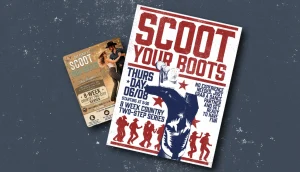
Fast Company recently explored this exact problem through designer Elizabeth Martin’s “AI vs. Designer” project, where she takes AI-generated posters and redesigns them using actual graphic design principles. The difference is not simply that the human version looks “nicer.” It is that it has hierarchy, restraint, intention and a clear understanding of where the eye should go first.
That is where AI still falls short.
AI can respond to a prompt and include every requested element, but graphic design is not just about fitting everything onto the page. A designer decides what matters most, what can disappear entirely, what needs space and what will actually connect with the person looking at it.
And consumers are starting to notice when that human judgement is missing.
Your customers can tell and that matters.
AI-generated content is becoming easier to recognise, and audiences are getting better at spotting it.
Bynder’s research found that 50% of consumers could correctly identify AI-generated content, with millennials aged 25 to 34 proving especially good at picking up on the signs.
What matters more is how that recognition affects perception.
When social content felt AI-generated, 25% of consumers said the brand came across as impersonal, 20% described it as untrustworthy, another 20% as lazy and 19% as uncreative. More than half also said they were less likely to engage with content they believed had been created by AI.
For brands, that is where the risk sits.
A design might be quick, cheap and technically impressive, but if it feels generic or disconnected from the brand behind it, people notice. And once that sense of authenticity is lost, trust can go with it.
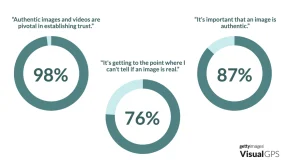
That concern is reflected in Getty Images’ research too, which found 98% of consumers see authentic imagery as important to trust, while 76% say it is becoming harder to tell what is real and what is not.
As synthetic content becomes more common, the value of work that still feels distinctly human is only increasing.
AI did not suddenly invent creative automation.
What makes all of this interesting is that AI and creativity are not actually a new combination.
Artists have been experimenting with machine-assisted creativity for decades. British painter Harold Cohen began creating AI-generated artwork in the 1970s using a program called AARON, which analysed visual information and produced new compositions based on coded instructions. Read more here.
Even then, people were asking the same question we are asking now: Who is actually creating the work?
The technology has obviously changed dramatically since then. Modern AI can create customised imagery in seconds and produce visual assets at a scale that would have been unimaginable in Cohen’s time.
But the debate has stayed surprisingly similar.
AI can assist with creative production. It can suggest. It can speed things up. It can help generate possibilities.
The question is whether it can replace the person making the creative decisions. We’ll let you decide for yourselves ⬇️
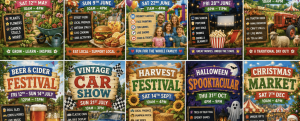
Image Source: https://www.design-monkey.co.uk/insights/why-are-ai-posters-a-problem
Graphic design is more than making something look good
This is where the AI poster epidemic becomes more than a funny internet trend. It exposes a bigger misunderstanding of what graphic design actually is.
Graphic design is visual communication. It is knowing where the viewer should look first, how to guide their eye and how to use hierarchy, spacing, contrast and composition to make information feel clear rather than chaotic. It is also understanding the difference between what a client wants to include and what an audience actually needs to see.
Sometimes a design needs more. Often, it needs less.
AI can generate an enormous number of options in seconds, but a graphic designer knows which direction is worth pursuing, what needs refining and when something simply is not working.
Originality matters more. Taste matters more. Human perspective matters more. That is a hill everyone on our team is willing to die on.
If your business is ready to drop the AI slop and move onto better things, our door is wide open.
Book your free meeting here.
Or, to view our authentic, human work: Click here.